No. CW650 IO provides the necessary air management components. The layout of CW650 IO should be evaluated together with the room envelope, door arrangement, exhaust point, usage procedure, and on-site verification.
Frequently Asked Questions about ASEPTIZER
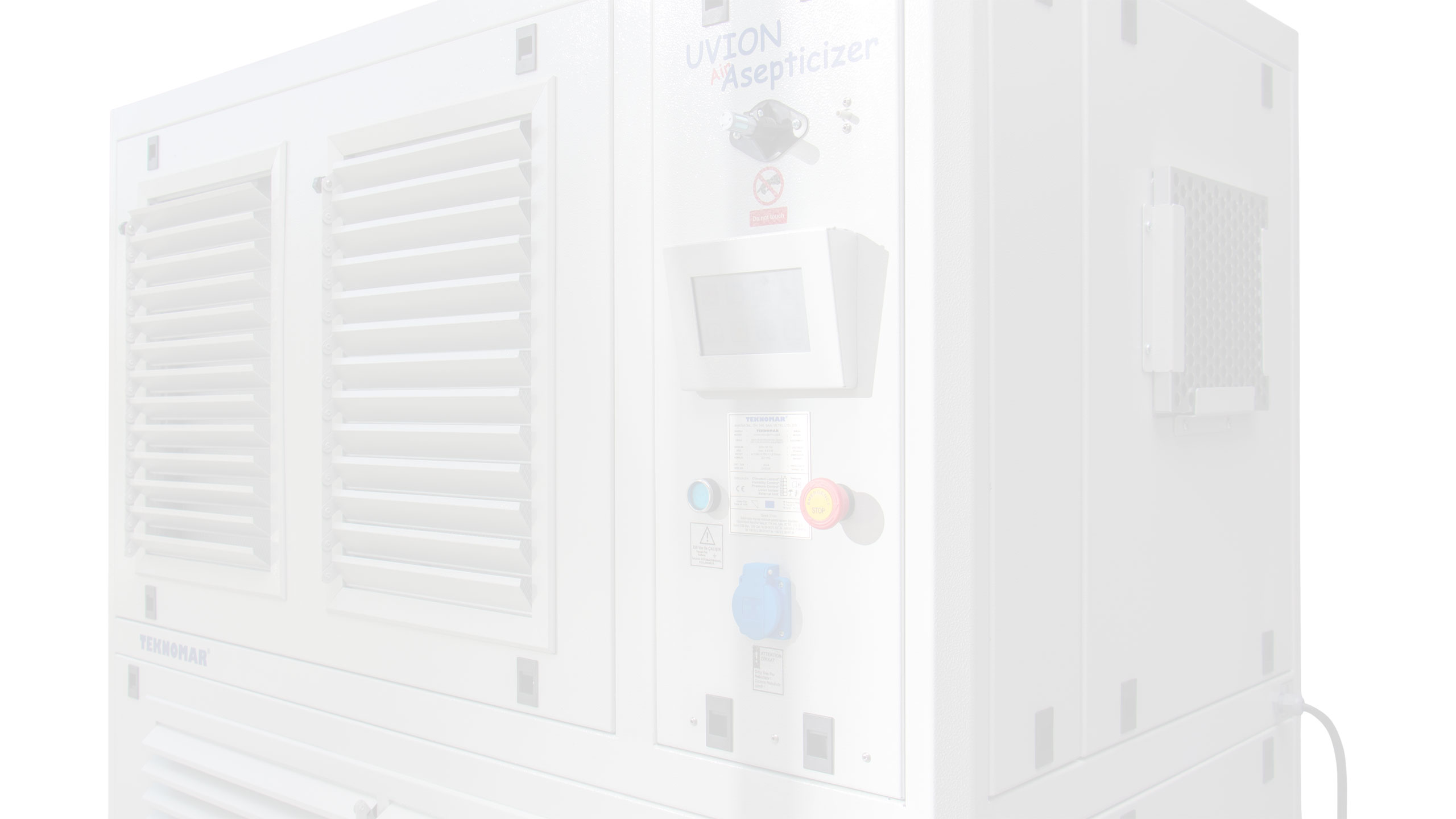
In many existing rooms, a more limited intervention is aimed for compared to extensive central HVAC renovation. However, exhaust ducting, electrical work, condensate drainage, room airtightness, or diffuser arrangement may be required.
Giving a single maximum room value is not technically correct. Room volume, target ACH, exhaust requirement, thermal load, duct losses, door traffic, and room airtightness must be calculated together.
An optional configuration can technically be offered. However, the clinical room function should not be changed without facility risk assessment, duct and exhaust control, cleaning, user procedure, and recommissioning.
No. The H14 filter is the system's high-efficiency particle retention component. The ISO 14644 room class is verified by measuring particle concentration in the completed area and cannot be derived from device flow rate alone.
Calendar time alone is not sufficient. Differential pressure, filter load, operating hours, device alarms, and manufacturer maintenance instructions are taken together as the basis.
FLEX is an airflow and control architecture that can be adapted to different project requirements. It does not mean that a clinical room can be switched between positive and negative functions in an uncontrolled manner during daily use.
No. The product integrates filtration, pressure, and air conditioning functions at room level. Building outside air design, central HVAC loads, and facility-wide air balance are evaluated separately.
The technical configuration may allow this. A clinical function change requires risk assessment, cleaning, duct and exhaust control, user procedure, and recommissioning measurements.
A single maximum room value is not technically sufficient. Room volume, target ACH, outside air, pressure difference, thermal load, duct losses, door traffic, and airtightness must be calculated together.
No. CW1000 FLEX is an engineering component for the targeted air quality. The ISO 14644 class is verified by on-site measurement of particle concentration in the completed area.
Filter differential pressure, operating hours, intensity of use, device alarms, and manufacturer maintenance instructions are evaluated together.
CW1350 is effective in volumes of 130 and 170 m³ depending on the Class status of the preferred environment. When performing Class calculation, the environment, target ACH, fresh air requirement, thermal load, door traffic, room airtightness, and process conditions are calculated together.
The H14 filter and high air flow rate are strong infrastructure components; room classification is verified by particle measurement and relevant field tests in the completed area. If ambient conditions are suitable, Class 10000 - Class 100000 Clean Room Standards are achieved.
CW1350 provides integrated air management at room level. In places without an HVAC system, CW1350 provides air conditioning locally.
CW 1350 is an electronic platform. It indicates its own filter clogging differentially 1 month in advance; as a manufacturer recommendation, filter replacement is recommended every 6 months. Details are available in the DataSheet.